Real Estate Information Archive

Blog

Displaying blog entries 71-80 of 372

Happy Valentines Day

by Liz Warren

We're Not in a Housing Bubble on Mt. Hood

by Liz Warren

3 Reasons We’re Definitely Not in a Housing Bubble on Mt. Hood

3 Reasons We’re Definitely Not in a Housing Bubble | MyKCM
 

Home values appreciated by about ten percent in 2020, and they’re forecast to appreciate by about five percent this year. This has some voicing concern that we may be in another housing bubble like the one we experienced a little over a decade ago. Here are three reasons why this market is totally different.

1. This time, housing supply is extremely limited

The price of any market item is determined by supply and demand. If supply is high and demand is low, prices normally decrease. If supply is low and demand is high, prices naturally increase.

In real estate, supply and demand are measured in “months’ supply of inventory,” which is based on the number of current homes for sale compared to the number of buyers in the market. The normal months’ supply of inventory for the market is about 6 months. Anything above that defines a buyers’ market, indicating prices will soften. Anything below that defines a sellers’ market in which prices normally appreciate.

Between 2006 and 2008, the months’ supply of inventory increased from just over 5 months to 11 months. The months’ supply was over 7 months in twenty-seven of those thirty-six months, yet home values continued to rise.

Months’ inventory has been under 5 months for the last 3 years, under 4 for thirteen of the last fourteen months, under 3 for the last six months, and currently stands at 1.9 months – a historic low.

Remember, if supply is low and demand is high, prices naturally increase.

2. This time, housing demand is real

During the housing boom in the mid-2000s, there was what Robert Schiller, a fellow at the Yale School of Management's International Center for Finance, called “irrational exuberance.” The definition of the term is, “unfounded market optimism that lacks a real foundation of fundamental valuation, but instead rests on psychological factors.” Without considering historic market trends, people got caught up in the frenzy and bought houses based on an unrealistic belief that housing values would continue to escalate.

The mortgage industry fed into this craziness by making mortgage money available to just about anyone, as shown in the Mortgage Credit Availability Index (MCAI) published by the Mortgage Bankers Association. The higher the index, the easier it is to get a mortgage; the lower the index, the more difficult it is to obtain one. Prior to the housing boom, the index stood just below 400. In 2006, the index hit an all-time high of over 868. Again, just about anyone could get a mortgage. Today, the index stands at 122.5, which is well below even the pre-boom level.

In the current real estate market, demand is real, not fabricated. Millennials, the largest generation in the country, have come of age to marry and have children, which are two major drivers for homeownership. The health crisis is also challenging every household to redefine the meaning of “home” and to re-evaluate whether their current home meets that new definition. This desire to own, coupled with historically low mortgage rates, makes purchasing a home today a strong, sound financial decision. Therefore, today’s demand is very real.

Remember, if supply is low and demand is high, prices naturally increase.

3. This time, households have plenty of equity

Again, during the housing boom, it wasn’t just purchasers who got caught up in the frenzy. Existing homeowners started using their homes like ATM machines. There was a wave of cash-out refinances, which enabled homeowners to leverage the equity in their homes. From 2005 through 2007, Americans pulled out $824 billion dollars in equity. That left many homeowners with little or no equity in their homes at a critical time. As prices began to drop, some homeowners found themselves in a negative equity situation where the mortgage was higher than the value of their home. Many defaulted on their payments, which led to an avalanche of foreclosures.

Today, the banks and the American people have shown they learned a valuable lesson from the housing crisis a little over a decade ago. Cash-out refinance volume over the last three years was less than a third of what it was compared to the 3 years leading up to the crash.

This conservative approach has created levels of equity never seen before. According to Census Bureau data, over 38% of owner-occupied housing units are owned ‘free and clear’ (without any mortgage). Also, ATTOM Data Solutions just released their fourth quarter 2020 U.S. Home Equity Report, which revealed:

“17.8 million residential properties in the United States were considered equity-rich, meaning that the combined estimated amount of loans secured by those properties was 50 percent or less of their estimated market value…The count of equity-rich properties in the fourth quarter of 2020 represented 30.2 percent, or about one in three, of the 59 million mortgaged homes in the United States.”

If we combine the 38% of homes that are owned free and clear with the 18.7% of all homes that have at least 50% equity (30.2% of the remaining 62% with a mortgage), we realize that 56.7% of all homes in this country have a minimum of 50% equity. That’s significantly better than the equity situation in 2008.

Bottom Line

This time, housing supply is at a historic low. Demand is real and rightly motivated. Even if there were to be a drop in prices, homeowners have enough equity to be able to weather a dip in home values. This is nothing like 2008. In fact, it’s the exact opposite.

Mt. Hood Land Swap

by Liz Warren

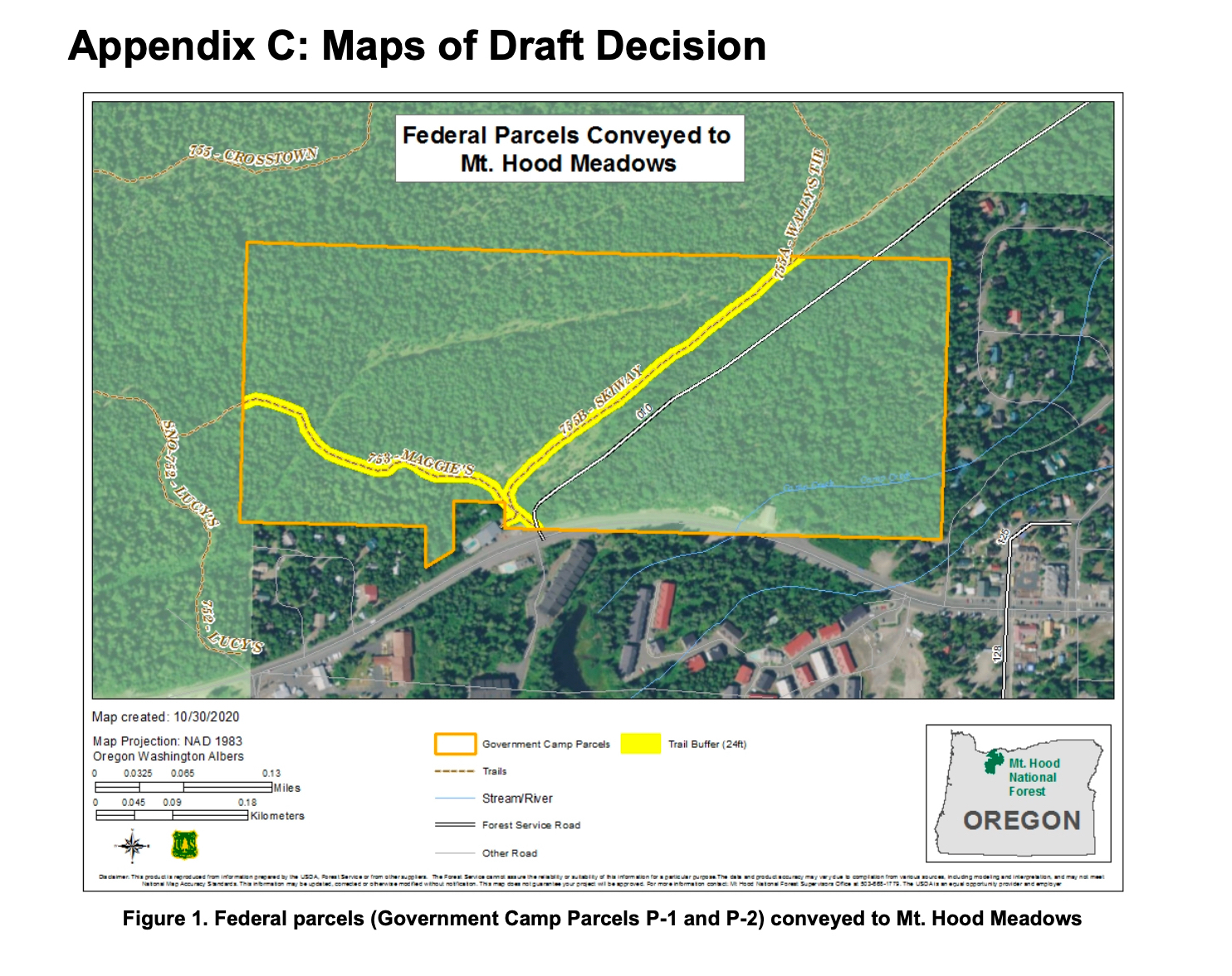
The Mt. Hood land swap is back in the news! Negotiations between the U.S. Forest Service with land next to Government Camp and Mt. Hood Meadows owned Cooper Spur ski area continues. Two decades later it is back in the news with a final decision on the environmental impact by the Feds and a draft decision of terms. 

This recent article in the Oregonian gives a good background on the history of the swap along with past and future challenges of the appraised values of the parcels.

If you would like to read the draft of the final decision the 40 page document is HERE.

Map of swap area

Government Camp Land Swap


Mt. Hood National Forest Storm Damage

by Liz Warren

Here's the latest information for Mt. Hood National Forest Cabin owners concerning our recent wind and rain storm:

Summer Recreation Residences

January 12- 13 Storm Damage Alert

Due to the wind and rainstorm, there are many downed trees and downed power lines in the recreation residence tract.  PGE and forest employees are working on clearing roads, prioritizing those who are trapped behind storm debris. This work will take several days.  In the meantime: 

  • Please postpone a visit to cabins.  There are many safety hazards in the area, including downed power lines.
  • First responders and work crews are out working and making progress- it is very important to not impede their work or block roads. 
  • Road 12 (Still Creek Rd.) is blocked and requires heavy equipment to remove a giant downed tree.
  • The Zigzag Ranger District and many of its employees are without internet, phones, and/or power.  
  • As staff gets safe road access they will assess recreation residences for damage and notify owners of discovered damage.

Why You Need to Buy A Home on Mt. Hood in 2021!

by Liz Warren


New COVID-19 Eviction Law

by Liz Warren

This information is straight from the Oregon Realtor Association Website:


HB 4401: Oregon’s New COVID-19 Eviction Law Summary and FAQs

(January 1, 2021)

House Bill 4401, which was passed December 20, 2020, extends the eviction moratorium through June 2021 and creates a $150 million compensation fund for rental property owners, as well as another $50 million for a tenant fund to be used for rent. The owner compensation fund will be available to any rental property owner who is owed back rent, though it will require forgiving 20% of the rental debt.

The bill will require tenants to sign a declaration that they have been impacted by COVID-19 in order to delay rental payments. If they do not sign, they may be evicted with 10 days’ notice.

FREQUENTLY ASKED QUESTIONS


Happy New Year From Mt. Hood!

by Liz Warren

Here’s to a Wonderful 2021!

Here's to a Wonderful 2021! | MyKCM

Special Session Update for House Bill 4401

Here is the newest information on the Clackamas County policies for vacation rentals in unincorporated Clackamas County. 

Good afternoon,


Yesterday the Clackamas County Board of County Commissioners took final action to officially allow short-term rentals in unincorporated Clackamas County, effective Jan. 17, 2021.  This follows Board action on Nov. 25 to approve amendments to the County Code, including a registration program and regulations for short-term rentals, that are scheduled to go into effect July 1, 2021.


These actions took place after extensive public outreach, Planning Commission meetings and public hearings and Board public hearings.  Links to the final approved language are available at www.clackamas.us/planning/str


Questions about the new amendments may be directed to Principal Planner Martha Fritzie at [email protected] or Planning & Zoning, Development Services Building, 150 Beavercreek Road, Oregon City, OR 97045.


We’ll keep you posted about implementation of related regulations.  Thank you and be well.


Ellen Rogalin, Community Relations Specialist

Clackamas County Public & Government Affairs

Transportation & Development | Business & Community Services

503-742-4274  | 150 Beavercreek Road, Oregon City, OR 97045

Office hours:  9 am – 6 pm, Monday-Friday

Get Your Christmans Tree On Mt. Hood and Enjoy the Outdoors!

by Liz Warren

Here's a great opportunity to get an affordable Christmas tree in the Mt. Hood National Forest. The forests are open and all you need is a permit. You may purchase a permit for up to five trees per household! Permits are only $5.00 per tree!!!!!!

Mt. Hood Christmas TreeHere are the locations where your permit can be purchased direct from the Mt. Hood National Forest website:

Tygh Valley General Store, 57715 Tygh Valley Road, Tygh Valley, OR. 541-483-2324
Open Monday-Friday 7:00 a.m. to 6:00 p.m., Saturday & Sunday 8:00 a.m. to 6:00 p.m.

Kramers Market, 121 Main Street, Dufur, OR. 541-467-2455
Open Monday-Saturday 7:00 a.m. to 7:00 p.m., Sunday 8:00 a.m. to 7:00 p.m.

Wamic Market and Supply, 57016  Wamic Market Rd. Wamic, Or, 97063. 541-544-2333
Open 7 days a week – 8:00 a.m. - 6:00 p.m.

Tum-A-Lum Lumber, 408 Hwy 35, Hood River, OR. 541-386-1001
Open Monday-Friday, 7:00 a.m. to 6:30 p.m., Saturday 8:00 a.m. to 5:00 p.m., Sunday 8:00 a.m. to 4:00 p.m.

Estacada Tackle Shop, 210 SE Hwy 224, Estacada, OR. 503-630-7424
Open 7 days a week 6:00 a.m. to 10:00 p.m.

Estacada True Value Hardware, 310 SE Main St, Estacada, OR. 503-630-3769
Open Monday-Saturday 8 a.m. to 7 p.m., Sun 9a.m. to 5p.m.

ACE Heritage Hardware, 39181 Pioneer Boulevard, Sandy, OR. 503-668-8731
Open Monday-Saturday 8:00 a.m. to 6:00 p.m., Sunday 9:00 a.m. to 5:00 p.m.

Hoodland Thriftway, 68280 Highway 26, Welches, OR. 503-622-3244
Open Daily: 7:00 a.m. to 11:00 p.m.

Mt. Hood Village Market, 73265 Highway 26, Rhododendron, OR 97049. 503-622-4652. Open Daily: 6:00 a.m. to 10:00 p.m.

Welches Mountain Building Supply, 67250 Highway 26, Welches, OR 97067.  503-622-3000. Open Daily:  8:00 a.m. - 6:00 p.m.

Sportsman’s Warehouse, 9401 SE 82nd Ave, Portland, OR. 503-777-8700
Open Monday-Saturday 9:00 a.m.-9:00 p.m., Sunday 10:00 a.m. - 6:00 p.m.

More info from the Mt. Hood National Forest Website

Displaying blog entries 71-80 of 372

Syndication

Categories

Archives