Housing Experts Forecast for the Rest of 2022 on Mt. Hood
Monday, September 19, 2022
Add Comment
Displaying blog entries 371-380 of 1996

If recent headlines about the housing market cooling and buyer demand moderating have you worried you’ve missed your chance to sell, here’s what you need to know. Buyer demand hasn’t disappeared, it’s just eased from the peak intensity we saw over the past two years.
During the pandemic, mortgage rates hit record lows, and that spurred a significant rise in buyer demand. This year, as rates increased due to factors like rising inflation, buyer demand pulled back or softened as a result. The latest data from ShowingTime confirms this trend (see graph below):
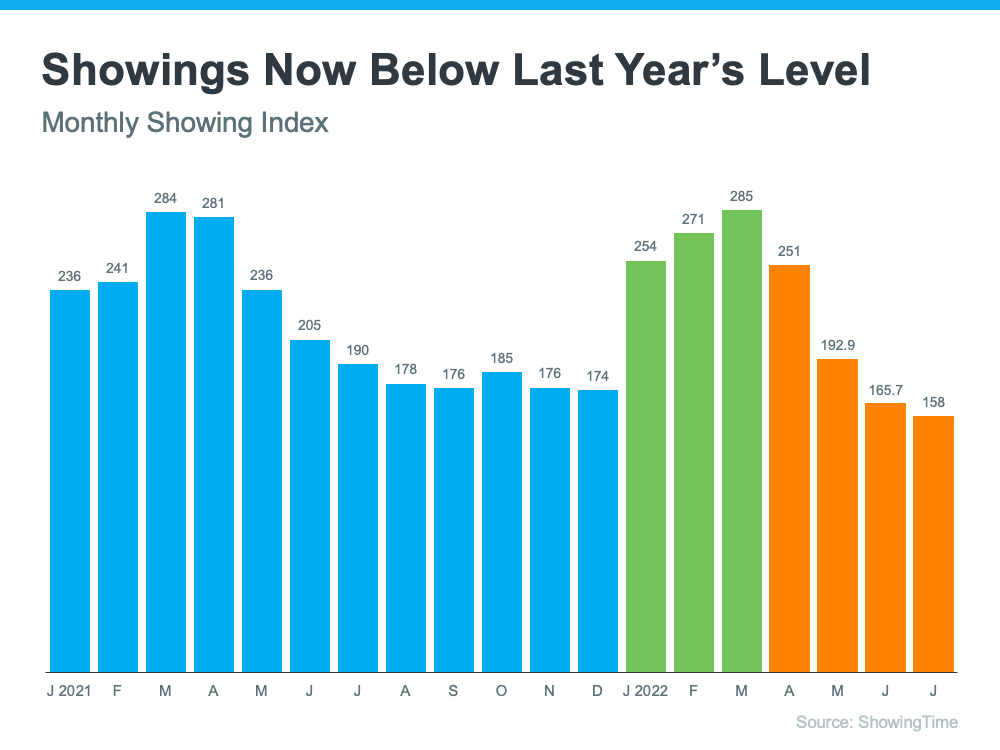
The orange bars in the graph above represent the last few months of data and the clear cooldown in the volume of home showings the market has seen since mortgage rates started to rise. But context is important. To get the full picture of where today's demand stands, let's look at the July data for the past six years (see graph below):
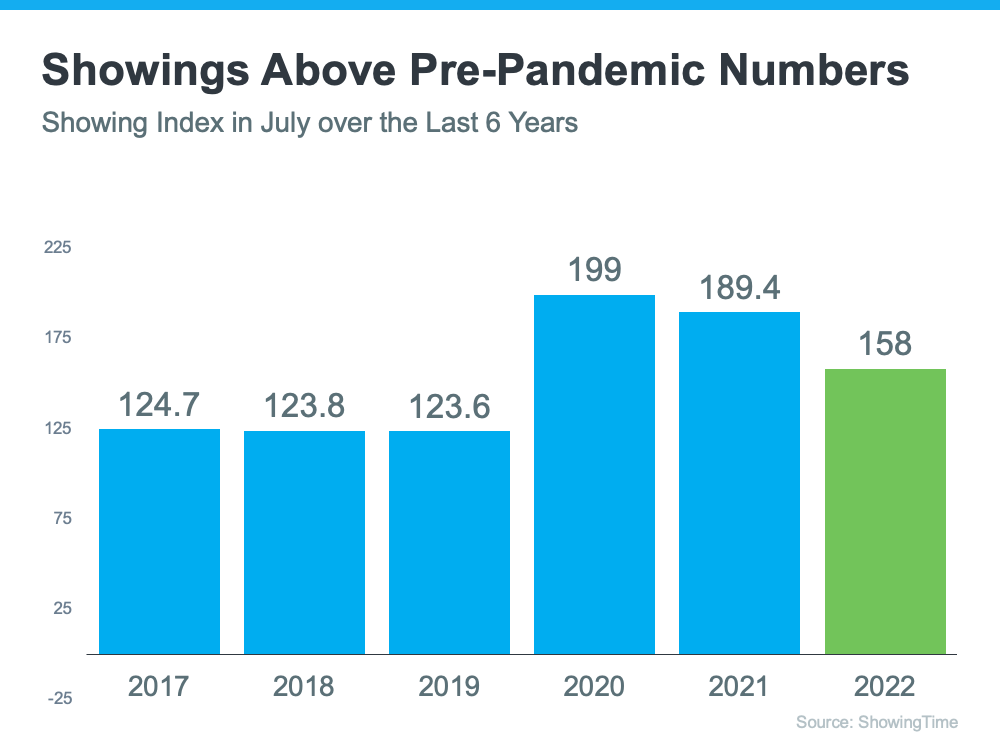
This second visual makes it clear that, while moderating compared to the frenzy in 2020 and 2021, showing activity is still beating pre-pandemic levels – and those pre-pandemic years were great years for the housing market. That goes to show there’s still demand if you sell your house today.
The key to selling in a changing market is understanding where the housing market is now. It’s not the same market we had last year or even earlier this year, but that doesn’t mean the opportunity to sell has passed.
While things have cooled a bit, it’s still a sellers’ market. If you work with a trusted local expert to price your house at the current market value, the demand is still there, and it should sell quickly. According to a recent survey from realtor.com, 92% of homeowners who sold in August reported being satisfied with the outcome of their sale.
Buyer demand hasn’t disappeared, it’s just moderated this year. If you’re ready to sell your house today, let’s connect so you have expert insights on how the market has shifted and how to plan accordingly for your sale.
Less than two months after the Oregon Land Conservation and Development Commission adopted the well-intentioned but ill-advised “Climate Friendly and Equitable Communities” rules that will increase the costs and complications of developing housing in Oregon, DLCD is at it again.
This time, in the name of “Wildfire Adapted Communities” DLCD is again proposing regulations that would dampen Oregon’s housing supply and choice at a time when we face the worst housing crisis in our state’s history, and in the nation.
The draft recommendations include items such as limiting where housing and commercial development can be located, requiring fire breaks in addition to the defensible space requirements for individual lots, and limiting where critical facilities such as schools, hospitals, and community lifelines can be sited.
The Legislature directed DLCD to report back by October 1, 2022 regarding “updates to the statewide land use planning program and local comprehensive plans and zoning codes that are needed in order to incorporate wildfire risk maps and minimize wildfire risk.”
The problem is, there are no maps. The Wildfire Risk Maps were pulled last month after major errors were identified and after strong public and community backlash.
Yet despite the fact that we don’t know where the regulations will apply, DLCD is charging ahead with them. That’s nonsensical. And now DLCD is using undefined terms like "areas of greatest wildfire risk” that, if interpreted broadly, could affect vast portions of the state.
To make matters worse, DLCD’s proposed requirements would apply above and beyond the new defensible space and home hardening regulations that are already being developed by other state agencies.
It’s important to protect our communities from wildfire risks. But we can’t develop regulations when we don’t know where they will apply. And any new regulations must not exacerbate Oregon’s housing crisis.
This is unjustifiable, and we must act now to stop it. Please email LCDC through the link below by Friday night and tell them not to advance their recommendation on new development considerations.
Written public comments delivered to the Commission Assistant at least 10 days prior to the meeting can be copied and distributed to the commission.
To submit comments electronically, please email the Commission Assistant at: est[email protected]
To mail in comments, please use this address:
Land Conservation and Development Commission
Attn: Esther Johnson, Commission Assistant
Oregon Department of Land Conservation and Development
635 Capitol Street NE, Ste. 150
Salem, OR 97301
Here is the latest from PGE:
Dangerous conditions, extreme fire danger expected to prolong outage
PORTLAND, Ore., Sept. 9, 2022 — As of 1 p.m. today, PGE turned off power to approximately 30,000 customer homes and businesses located in 10 designated PSPS areas and two additional areas with high fire risk as a safety measure to help protect people, property and the environment.
The 10 designated PSPS areas are as follows: Mt. Hood Corridor and Foothills (Area 1); Columbia River Gorge (Area 2); Oregon City (Area 3); Estacada (Area 4); Scotts Mills (Area 5); Portland West Hills (Area 6); Tualatin Mountains (Area 7); Northwest Hills (Area 8); Central West Hills (Area 9); and Southern West Hills (Area 10).
In partnership with local officials, PGE also implemented preventive outages in two additional areas: Silverdale/Corbett and Silver Falls. PGE turned off power in these limited areas with higher risk of fire in response to unique and extreme weather conditions. If there is need identified by PGE and emergency responders to proactively shut off power in other areas to protect people and property, we will do so.
If the event duration is as anticipated and assuming there is no damage to our system, power restoration could begin as early as Saturday evening. Damage to our equipment and/or system could create delays in restoration timing. To help reduce the impact on affected customers and communities, PGE will provide updates at least every 24 hours until power is fully restored.
PGE Community Resource Centers are open from 7:00 a.m. to 7:00 p.m. every day, until power is fully restored to the areas. Information, bottled water, ice, access to charging for personal devices and Wi-Fi will be available. More information can be found on portlandgeneral.com/psps; locations include:
The State of Oregon and several counties are also providing resources. Call 2-1-1 or 1-866-698-6155 for a complete list of resources in your area.
PGE will monitor conditions and as soon as weather conditions return to normal, will begin inspecting all power lines and equipment to make necessary repairs so lines and equipment can be safely re-energized. PGE, contract and mutual assistance crews are preparing the system for restoration and responding to unplanned outages caused by high gusty winds, and when weather normalizes, will work as quickly as safety allows to restore power.
PGE will continue communicating directly with customers in the impacted areas and will share information with news media, social media and other channels. Customers can find the latest information on portlandgeneral.com/psps, by following PGE on social media -- @PortlandGeneral on Twitter and @PortlandGeneralElectric on Facebook or by calling customer service at 503-228-6322. Our advisors can provide assistance in more than 200 languages.
###
About Portland General Electric Company: Portland General Electric (NYSE: POR) is a fully integrated energy company based in Portland, Oregon. The company serves approximately 900,000 customers with a service area population of 2 million Oregonians in 51 cities. PGE owns 16 generation plants across Oregon and other Northwestern states and maintains and operates 14 public parks and recreation areas. For more than 130 years, PGE has powered the advancement of society, delivering safe, affordable, and reliable energy to Oregonians. PGE and its approximately 3,000 employees are working with customers to build a clean energy future. Together with its customers, PGE has the No. 1 voluntary renewable energy program in the U.S. PGE is committed to achieving at least an 80% reduction in greenhouse gas emissions from power served to customers by 2030 and 100% reduction by 2040. In 2021, PGE became the first U.S. utility to join The Climate Pledge. For the eighth year in a row PGE achieved a perfect score on the 2021 Human Rights Campaign Foundation's Corporate Equality Index, a national benchmarking survey and report on corporate policies and practices related to LGBTQ workplace equality. In 2021, PGE, employees, retirees, and the PGE Foundation donated $4.8 million and volunteered 15,760 hours with more than 300 nonprofits across Oregon. For more information visit www.PortlandGeneral.com/news.
Contact Info:
PGE Communications, [email protected]; 503-464-2067
Customer safety will drive a decision in the next 24-48 hours
PORTLAND, Ore., Sept. 7, 2022 —Portland General Electric announced that it is monitoring dangerous, high-risk fire conditions and is increasingly likely to call public safety power shutoffs (PSPSs) in 10 areas that are at a higher fire risk, affecting approximately 30,000 customer meters. A PSPS is when PGE turns off power in a limited, high-risk area to help reduce the risk of wildfire and to help protect people, property and the environment.
PGE is actively monitoring conditions and will make the decision based on factors including wind speed, temperature, humidity and the dryness of trees and brush, field observations and information from local fire departments and agencies. PGE will continue to monitor conditions for the next 24-48 hours and will provide an update. If conditions persist, PGE aims to provide up to four hours of notice before turning off power.
Weather forecasts indicate strong, gusty winds are predicted across PGE’s service area, starting as early as Friday morning. “PGE works year-round to help keep our system safe and resilient from wildfire, including managing over 2.2 million trees along 12,000 miles of power lines,” said Larry Bekkedahl, senior vice president of Advanced Energy Delivery, PGE. “However, we are expecting extreme winds that could cause outages. We are preparing to have crews at the ready to begin repairing damage following the high winds, as soon as conditions are safe.”
The 10 PSPS areas are shown in the map below. Customers in these areas should check portlandgeneral.com/pspsto confirm if their power may be impacted. PGE encourages everyone who may be impacted by a PSPS or a weather-related outage to make an emergency plan and prepare an outage kit using the preparedness information that PGE sent to customers and that is also available on PGE’s website.
If PGE calls a PSPS in these areas, PGE will shut off power as long as necessary to protect against the risk of fire. A PSPS can last for multiple days. After weather conditions return to normal, PGE will begin to visually inspect its equipment and make any repairs necessary to safely re-energize lines. Based on current information, PGE estimates a PSPS could be called on Friday morning, and power could be out through Saturday night. Assuming this event duration and no damage to our system, power restoration would begin Sunday morning and power to customers could be restored by Monday night.
If PGE calls a PSPS in these areas, Community Resource Centers will likely be opened to provide information, water, ice, Wi-Fi and access to charging for personal electronics. More information will be provided in future updates.
PGE is communicating directly with customers in the impacted areas and will also communicate through the news media, on portlandgeneral.com/psps and on social media, @PortlandGeneral on Twitter and @PortlandGeneralElectric on Facebook, among other channels.
Customer service is available at 503-228-6322 and service advisors can assist customers in more than 200 languages.
About Portland General Electric Company: Portland General Electric (NYSE: POR) is a fully integrated energy company based in Portland, Oregon. The company serves approximately 900,000 customers with a service area population of 2 million Oregonians in 51 cities. PGE owns 16 generation plants across Oregon and other Northwestern states and maintains and operates 14 public parks and recreation areas. For more than 130 years, PGE has powered the advancement of society, delivering safe, affordable, and reliable energy to Oregonians. PGE and its approximately 3,000 employees are working with customers to build a clean energy future. Together with its customers, PGE has the No. 1 voluntary renewable energy program in the U.S. PGE is committed to achieving at least an 80% reduction in greenhouse gas emissions from power served to customers by 2030 and 100% reduction by 2040. In 2021, PGE became the first U.S. utility to join The Climate Pledge. For the eighth year in a row PGE achieved a perfect score on the 2021 Human Rights Campaign Foundation's Corporate Equality Index, a national benchmarking survey and report on corporate policies and practices related to LGBTQ workplace equality. In 2021, PGE, employees, retirees, and the PGE Foundation donated $4.8 million and volunteered 15,760 hours with more than 300 nonprofits across Oregon. For more information visit www.PortlandGeneral.com/news.

Owning a home is a major financial milestone and an achievement to take pride in. One major reason: the equity you build as a homeowner gives your net worth a big boost. And with high inflation right now, the link between owning your home and building your wealth is especially important.
If you’re looking to increase your financial security, here’s why now could be a good time to start on your journey toward homeownership.
A report from the National Association of Realtors (NAR) details several homeownership trends, including a significant gap in net worth between homeowners and renters. It finds:
“. . . the net worth of a homeowner was about $300,000 while that of a renter’s was $8,000 in 2021.”
To put that into perspective, the average homeowner’s net worth is roughly 40 times that of a renter’s. This difference shows owning a home is a key step in achieving financial success.
The net worth gap between owners and renters exists in large part because homeowners build equity. When you own a home, your equity grows as your home appreciates in value and you make your mortgage payments each month. As a renter, you don’t have that same opportunity. A recent article from CNET explains:
“Homeownership is still considered one of the most reliable ways to build wealth. When you make monthly mortgage payments, you're building equity in your home . . . When you rent, you aren't investing in your financial future the same way you are when you're paying off a mortgage.”
But on top of that, your home equity grows even more as your home appreciates in value over time. That has a major impact on the wealth you build, as a recent article from Bankrate notes:
“Building home equity can help you increase your wealth over time, . . . A home is one of the only assets that have the potential to appreciate in value as you pay it down.”
In other words, when you own your home, you have the advantage of your mortgage payment acting as a contribution to a forced savings account that grows in value as your home does. And when you sell, any equity you’ve built up comes back to you. As a renter, you’ll never see a return on the money you pay out in rent every month.
Owning a home is an important part of building your net worth. If you’re ready to start on your journey to homeownership, let’s connect today.
Get ready for ski season! This end unit over looks the forest and creek at Collins Lake Resort in the heart of Government Camp. Three bedrooms and two and a half baths with tandem oversized garage. Easy walk to the pool and lodge. Grab the shuttle and take it to the slopes.
Updated unit with beautiful furnishings. Comes turn key ready! $750,000.
.jpeg)
.jpeg)
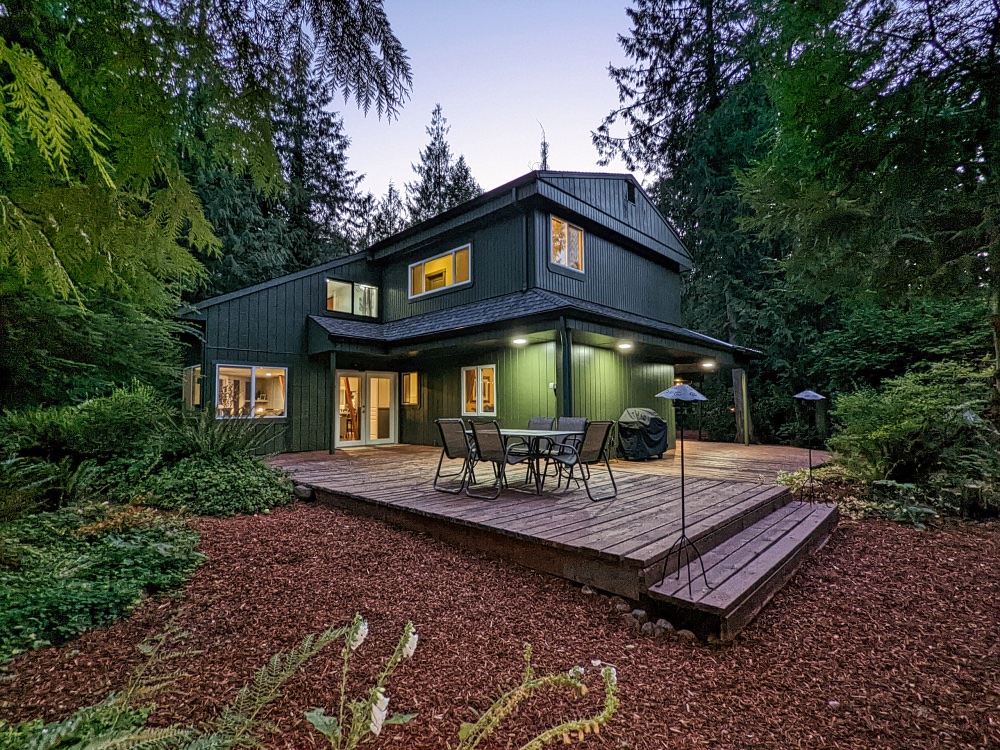
This successful three bedroom, three bath home is nearly 3,000 sq. ft. with updated kitchen and open floor plan. All level and usable land with lawn, garage, outbuildings and lots of privacy. Sit on your sunny deck and view Zig Zag Mountain. Take off for hiking trails or hit the slopes on 11 minutes away! Comes completely furnished. $775,000
.jpeg)
.jpeg)
.jpeg)
![Here's Why It's Still a Sellers' Market [INFOGRAPHIC] | MyKCM](https://files.mykcm.com/2022/09/01081742/20220902-MEM-1046x1874.png)
Displaying blog entries 371-380 of 1996