Far More Sellers Than Buyers Today
Tuesday, September 1, 2026

Add Comment
Displaying blog entries 1-10 of 362

Momentum is quietly building in the housing market. New data from NerdWallet shows more Americans are starting to think about buying a home again. Last year, 15% of respondents said they planned to buy a home in the next 12 months. This year, that number rose to 17%.
That 2% increase might not sound like a big jump, but in a market where buyer demand has been cooling for the past few years, it’s a sign things are starting to shift. More people are feeling ready (or at least closer to ready) to take the leap and buy a home in 2026.
And if you’re in that camp and buying a home is on your goal sheet this year, this is your nudge to connect with a local agent and a trusted lender to start laying the groundwork now.
If you’re eager to get the ball rolling right away, here's what to tackle first:
Even if buying feels like a late-2026 goal, this moment still matters. The buyers who feel the most confident later are usually the ones who quietly prepared earlier.
That doesn’t mean big financial commitments or major lifestyle changes. It just means setting yourself up so you’re ready when the timing is right. Here are a few low-stress ways to do that:
If buying a home in 2026 is on your radar, let’s start the conversation today. Not to rush a decision, but to make sure you know how to get ready for your moment.
Because every move (whether it’s next year or later) is smoother when it starts with a plan. And if you need help coming up with one that works, let’s connect.

Want to find the best deal possible on a home right now? Here’s one way to do it.
Take a look at the homes that have been sitting on the market the longest. Because the longer a house sits, the less it sells for.
And the data proves it. When a home lingers, sellers usually get more flexible.
That’s where buyers are scoring real savings. Even if a house sells for 94% of its asking price, that's roughly $24,000 off of a median priced home.
If you want to stretch your budget and find the deals other buyers overlook, let’s chat.

Renting can feel much less expensive and much simpler than buying a home, especially right now. No repairs, no property taxes, no worrying about mortgage rates – you just pay the bill and move on with your life.
But here’s the part people don’t talk about enough: renting doesn’t help you build your financial future. Meanwhile, homeowners grow their net worth just by owning a home.
So, if you’ve been wondering whether buying is still worth it, the long-term math is clearer than you might think.
Let’s break down one of the key differences between renting and buying. When you rent, your payment goes to your landlord, and then it’s gone. When you own, part of your payment comes back to you in the form of equity (the wealth you build as the value of your home increases, and you pay down your home loan).
So, while renting may seem more affordable now, you have to remember it comes at a long-term cost: you’re not building your wealth. And it turns out, that’s a bigger miss than you may expect.
First American recently analyzed the long-term financial impact of renting versus owning a home. They compared mortgage payments, property tax, insurance, repairs, and maintenance against the equity gained through home price appreciation and paying down the mortgage. And they did that during several different time frames to see if it tells a consistent story:
In each time frame, two things were true: renters ended up losing money over time. And homeowners gained it.
Here’s some data so you can see this play out. Each color represents one of the key time frames. The solid lines show the buyer’s investment over time and how their net worth actually grew the longer they lived in their home. The dashed line represents the renter’s investment. In the end, they sank more and more cash into renting without gaining any financial benefit.
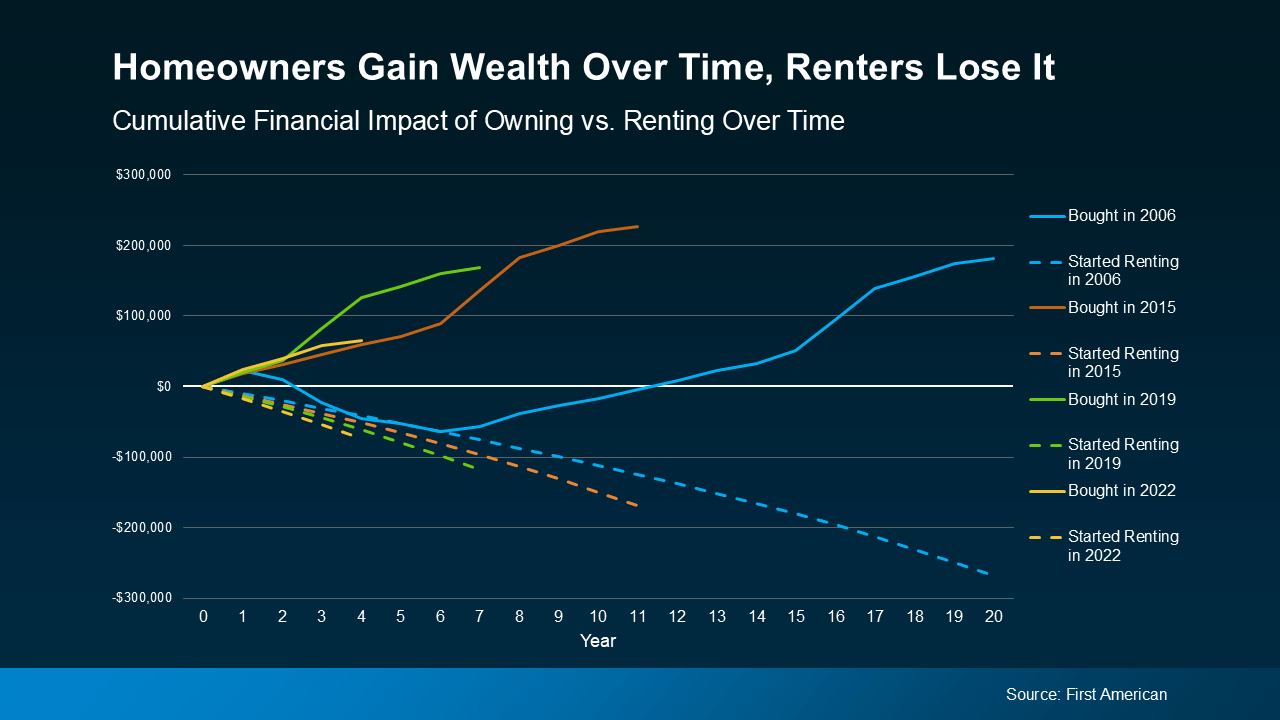 The takeaway is simple: time in a home builds wealth. Time renting doesn’t.
Basically, homeowners come out ahead. And the analysis shows that’s even after you factor in the other expenses that come with homeownership, like insurance, repairs, and property taxes. And that's the case for every time frame First American looked into.
On the flip side, renters spent money on their rent, but didn’t gain any long-term financial benefit. That’s true no matter what window of time you look at in the study.
Now, that doesn’t mean buying always beats renting in the short term. But the longer you own, the wider the wealth gap becomes.
You might still be thinking, “Okay, but buying feels out of reach for me right now.” Fair.
The past few years haven’t been easy for buyers. But things are starting to shift. Mortgage rates have come down this year, home prices are softening, and incomes have been rising. And according to Zillow, typical monthly payments have gotten a little easier compared to this time last year. Not by a lot, but enough to make a difference.
No, buying isn’t suddenly easy. But it is easier than it was just a few months ago. And in the long run, history shows it’s worth it.
Renting may feel less expensive today, but owning is what builds real wealth over time. And with affordability starting to improve, the path to homeownership may be opening up more than you think.
If you’re curious what buying could look like for you, let’s connect. We can figure out your next move, pressure-free.
If you’ve seen headlines or social posts calling for a housing crash, it’s easy to wonder if home values are about to take a hit. But here’s the simple truth.
The data doesn’t point to a crash. It points to slow, continued growth.
And sure, it’s going to vary by local area. Some markets will see prices rise more than others. And some may even see small, short-term declines. But the big picture is: home prices are expected to rise nationally, not fall, over the next 5 years.
In the Home Price Expectations Survey (HPES) from Fannie Mae, each quarter over 100 leading housing market experts weigh in on where they project home prices will go from here. And in the report that was just released, the experts agree prices are projected to climb nationally through at least 2029 (see graph below):
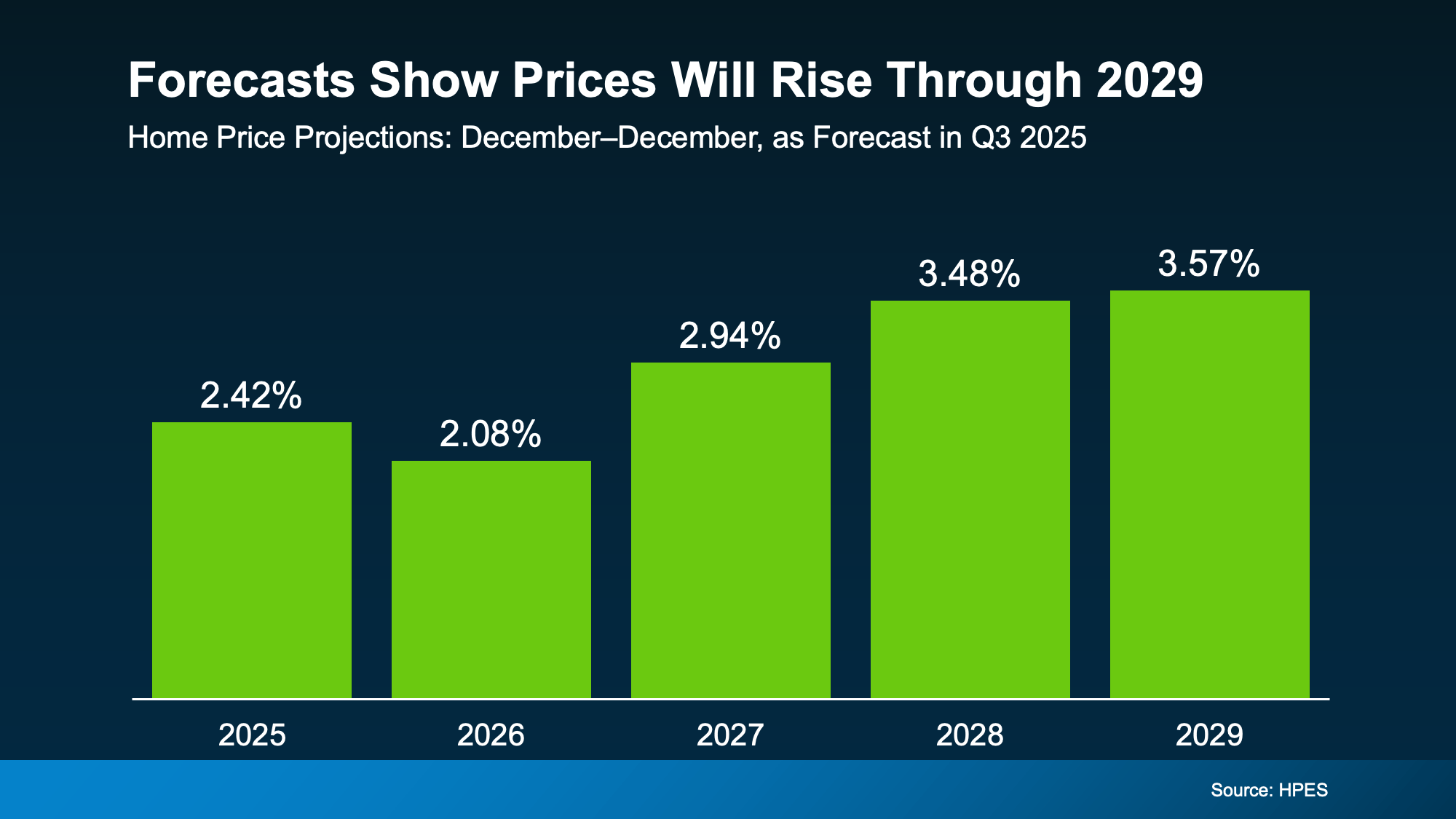 Here’s how to read this visual. Each bar in that graph shows an increase, not a loss. It’s just that the anticipated pace of that appreciation varies year-to-year.
And to further drive this home, let’s look at another view of where prices are and where they’re expected to go. In this version, the expert forecasts are broken into 3 categories: the overall average, the most optimistic projections, and the most pessimistic projections (see chart below):
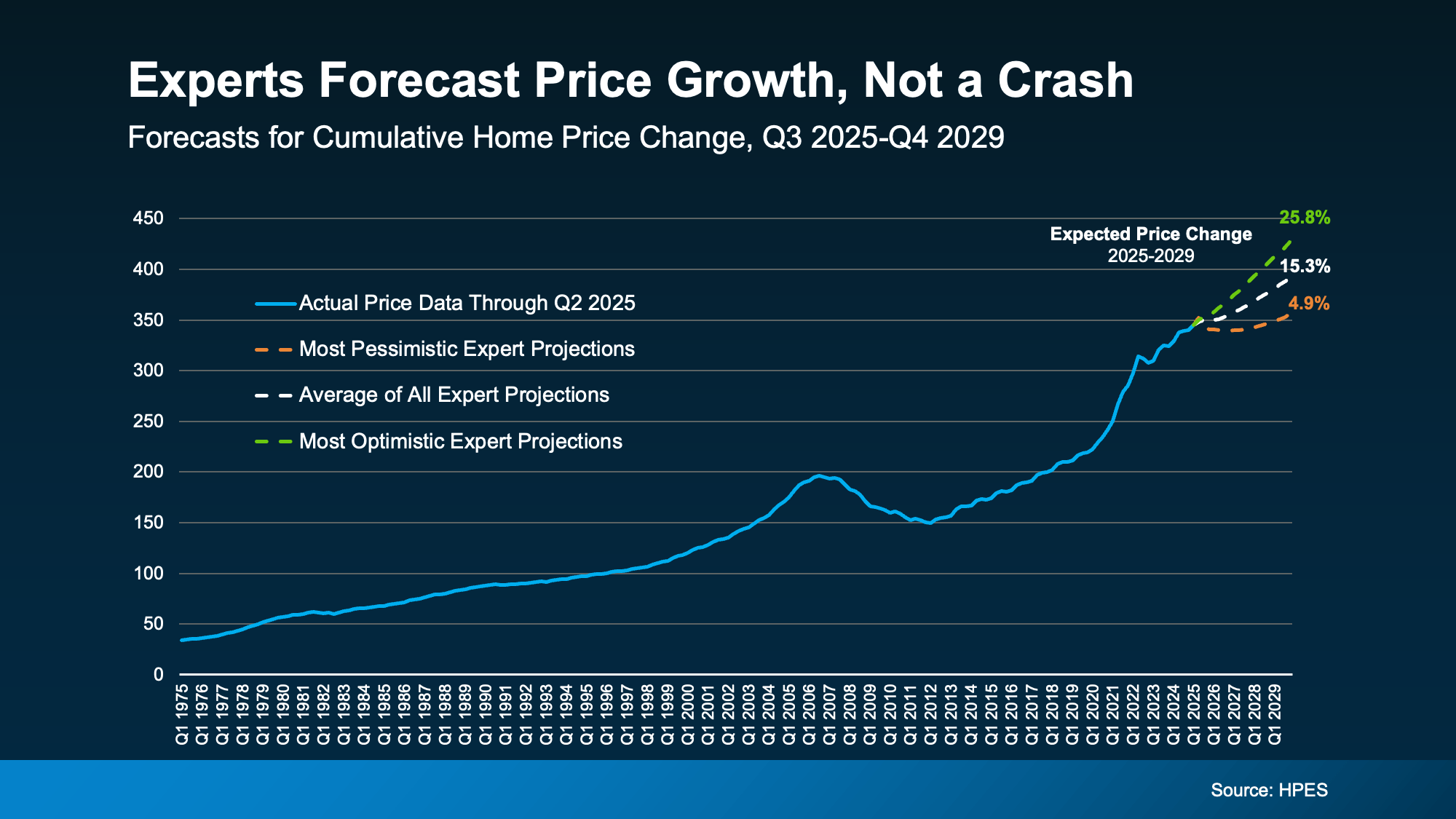 Notice how even the most pessimistic forecasters say we’ll see prices rise by almost 5% over the next few years.
What sticks out the most? None of these groups who study the market are forecasting a crash, or even a decline, over the next 5 years.
Now, focus back on the first graph. The projections call for 2-3.5% price increases in each of the next five years. For context, the average rate of appreciation for the last 25 years was closer to 4-5% annually.
So, while that’s slightly below the historical average, it’s much more sustainable and typical than where the market was in 2020, 2021, and 2022.
Back then, prices rose too much, too fast based on record-low supply and record-high demand. Some places even saw prices climb by 15-20%.
So, while it may feel like prices are stalling compared to those pandemic-era surges, what’s really happening is that the market is finally finding balance again.
A lot of the chatter about home prices today is based on that rapid rise and the old saying that what goes up, must come down. But historically, that’s not really true. Home prices almost always rise.
And the main reason we’re not heading for a repeat of 2008 is simple: supply and demand.
Even though affordability challenges have made it harder for some people to buy over the past few years, there still aren’t enough homes for everyone who wants one. And that ongoing shortage is keeping upward pressure on prices nationally.
That’s why experts across the board can confidently agree: we’re not headed for a price collapse, but for steady, long-term appreciation.
And just in case it’s the economy that’s got you worried, remember this. Over the past 50 years, there have been plenty of economic events that have impacted the market. And one thing that’s consistently been true throughout time is the housing market always recovers. And we’re coming through that turn right now and going into a recovery.
If you’ve been waiting to buy or sell because you’re worried about a crash, it’s time to look at the data – not the headlines.
The question isn’t if home prices will rise, it’s by how much.
Let’s connect so you know what’s happening in our local market and what these forecasts mean for your next move.

If your selling strategy still assumes you’ll get multiple offers over asking, it’s officially time for a reset. That frenzied seller’s market is behind us. And here are the numbers to prove it.
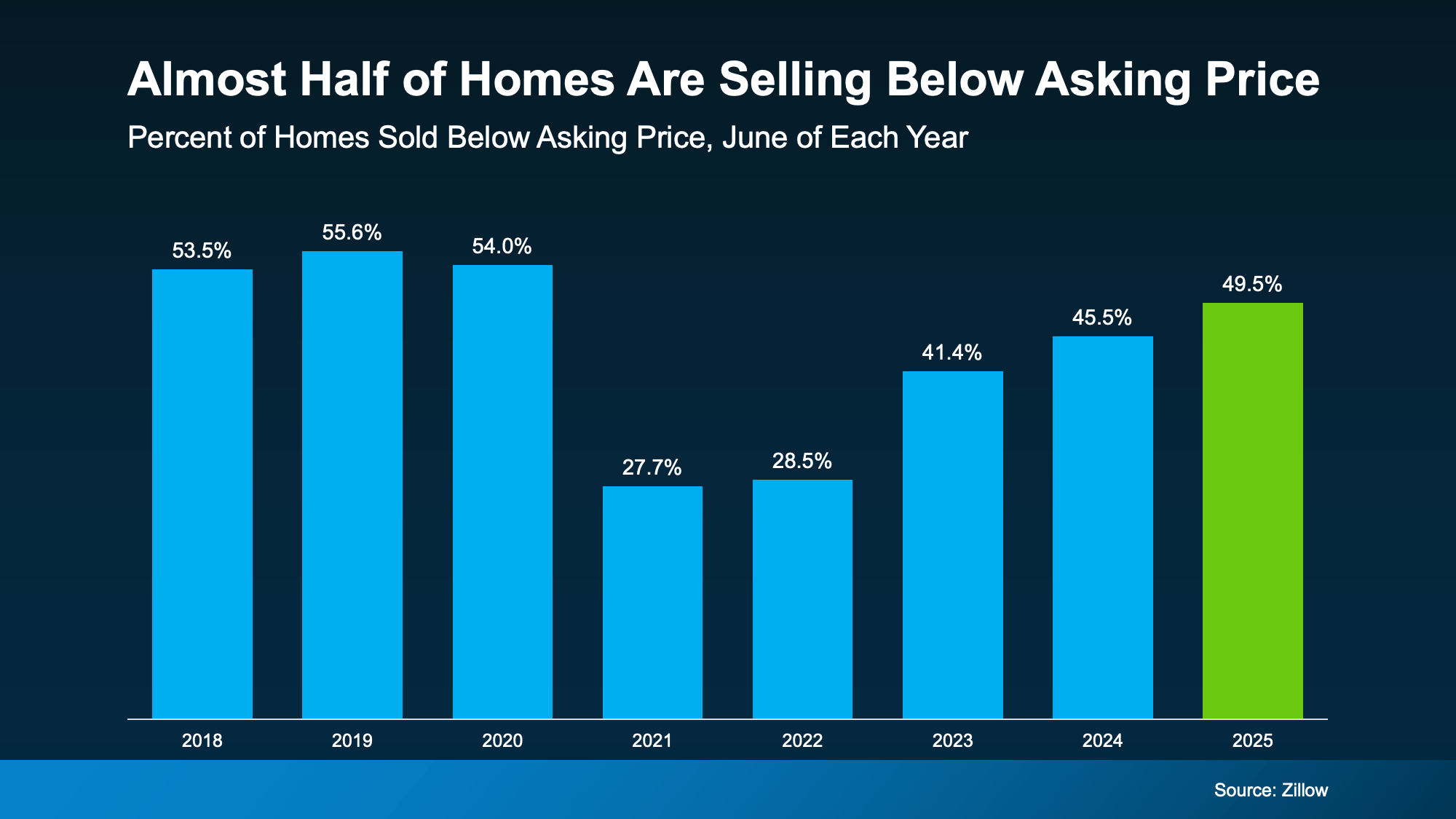
Right now, about 50% of homes on the market are selling for less than their asking price, according to the latest data from Cotality.
But that isn’t necessarily bad news, even if it feels like it. Here’s why. The wild run-up over the last few years was never going to be sustainable. The housing market needed a reset, and data shows that’s exactly what’s happening right now.
The graph below uses data from Zillow to show how this trend has shifted over time. Here’s what it tells us:
 Why This Matters If You’re Selling Your House
In this return to normal, your pricing strategy is more important than ever.
A few years ago, you could overprice your house and still get swarmed with offers. But now, buyers have more options, tighter budgets, and less urgency.
Today, your asking price can be make or break for your sale, especially right out of the gate. Your first two weeks on the market are the most important window because that’s when the most serious buyers are paying attention to your listing. Miss your price during that crucial period, and your sale will grind to a halt. Buyers will look right past it. And once your listing sits long enough to go stale, it’ll be hard to sell for your asking price.
Basically, sellers who cling to outdated expectations end up dealing with price cuts, lower offers, and a longer time just sitting on the market. But homeowners who understand what's happening are still winning, even today.
Because that stat about 50% of homes selling for under asking also means the other half are selling at or above – as long as they're priced right from the start.
So, how do you set yourself up for success? Do these 3 things:
If you want your house to be one that sells for at (or even more than) your asking price, it’s time to plan for the market you’re in today – not the one we saw a few years ago. And that’s exactly why you need a stand-out local agent.
You don’t want to fall behind in this market.
So, let's talk about what buyers in our area are paying right now. With local expertise and a strategy that gets your house noticed in those crucial first two weeks, anything is possible.
Want to know what your house would sell for?
Market Summary November Sales 2024
HAPPY NEW YEAR!
As we head into 2025 here is a brief recap of some stats of the 2024 market. Many real estate sites report that this was a very difficult year with so little inventory and high interest rates. Since the beginning of the year the average market absorption is 2.7 months which is a seller’s market and unbalanced based on all pricing points.
Once I removed the sales for Colton which are mapped into our area through RMLS, we had a total of 136 sales for the year. Here’s a rundown of some of the stats that may be interesting:
13 forest cabins sold
102 detached single family homes sold
11 sales were over $1,000,000
19 sales were in Government Camp
14 condos sold and 9 were in Government Camp
8 sales were in Mt. Hood RV Village with tiny homes
Predictions for 2025 include more inventory coming on the market. We’ll see how that plays out. Currently our mountain market has 36 active listings. There are nine currently pending. So we will see how much the inventory goes up soon after the holidays.
Interest rates, low inventory, and consumer debt are slowing buyers down. Here are predictions for interest rates in 2025. Consensus is that rates will be slightly lower than 2024 but if inventory doesn’t increase, buyers may be paying the same as a todays rates because prices will be higher.

Consumer debt is another obstacle. People are tapped out which makes saving for a home tough.
Consumer Debt

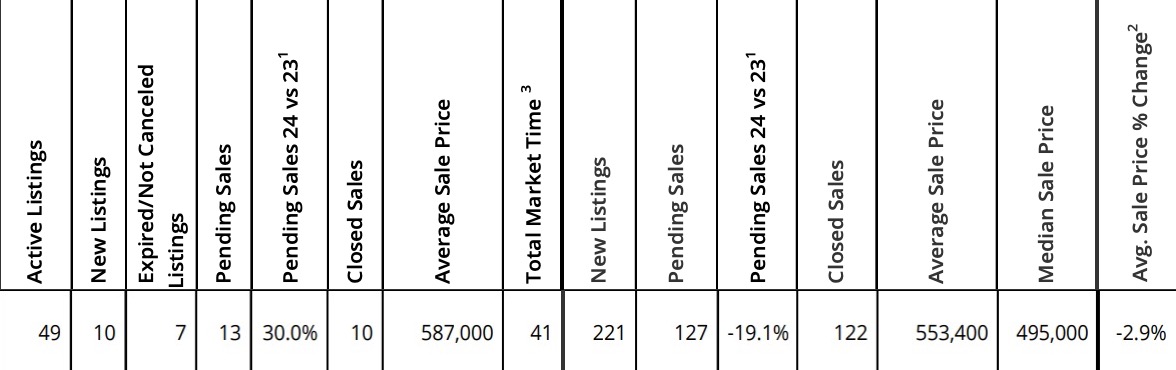
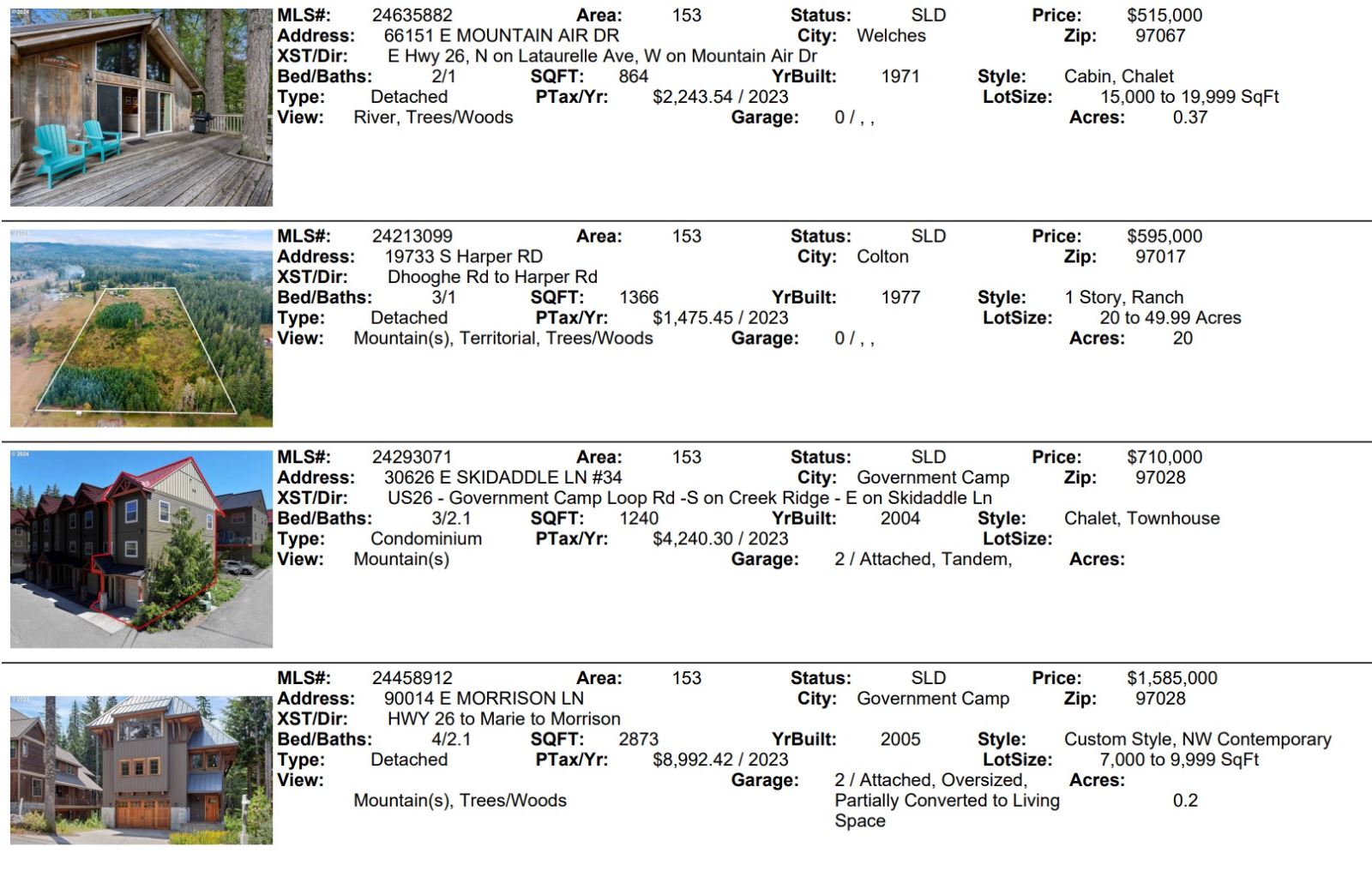
Here are the statistics for November 2024’s market from RMLS.
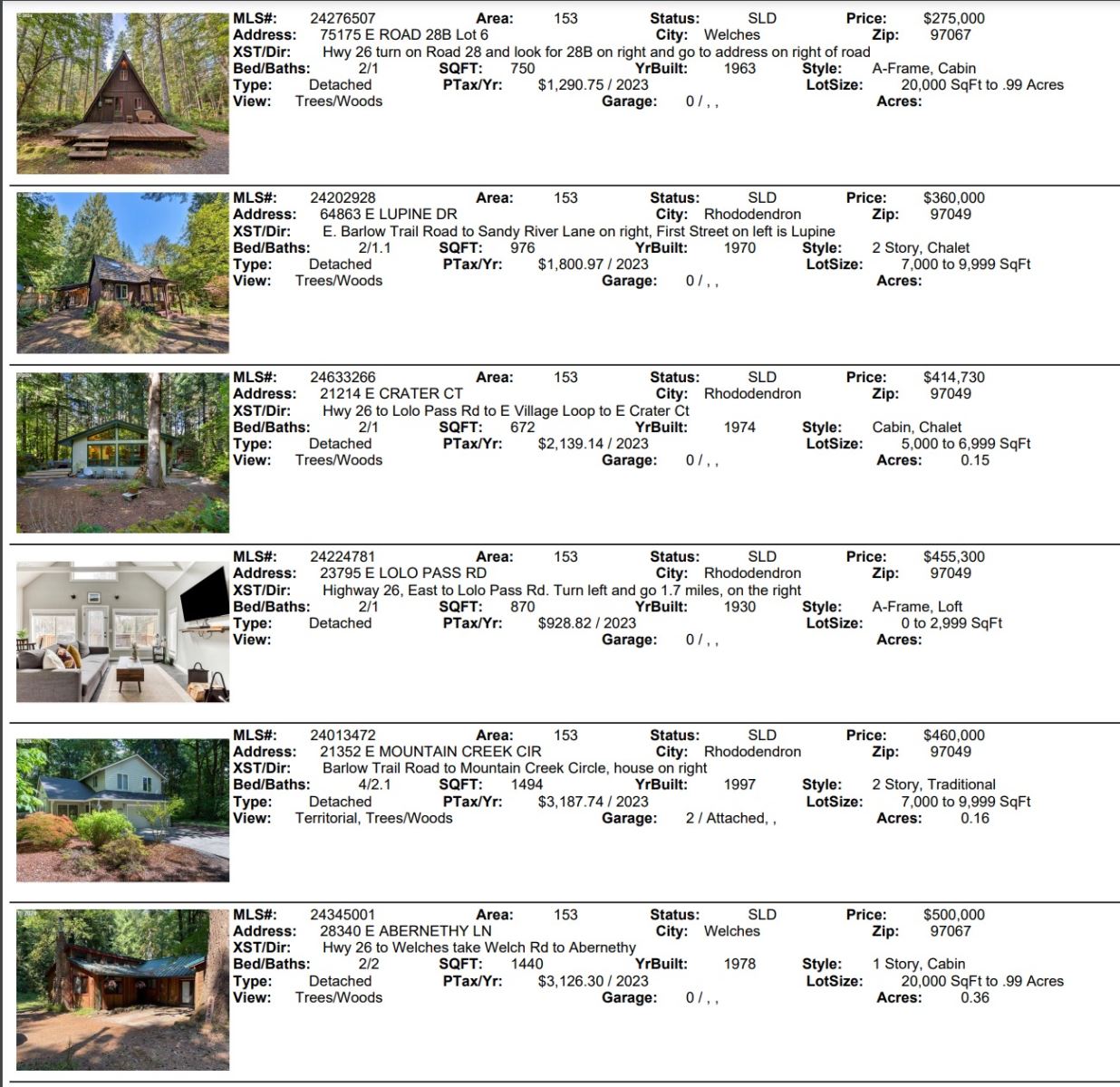
Listed below are the ten sales for November.
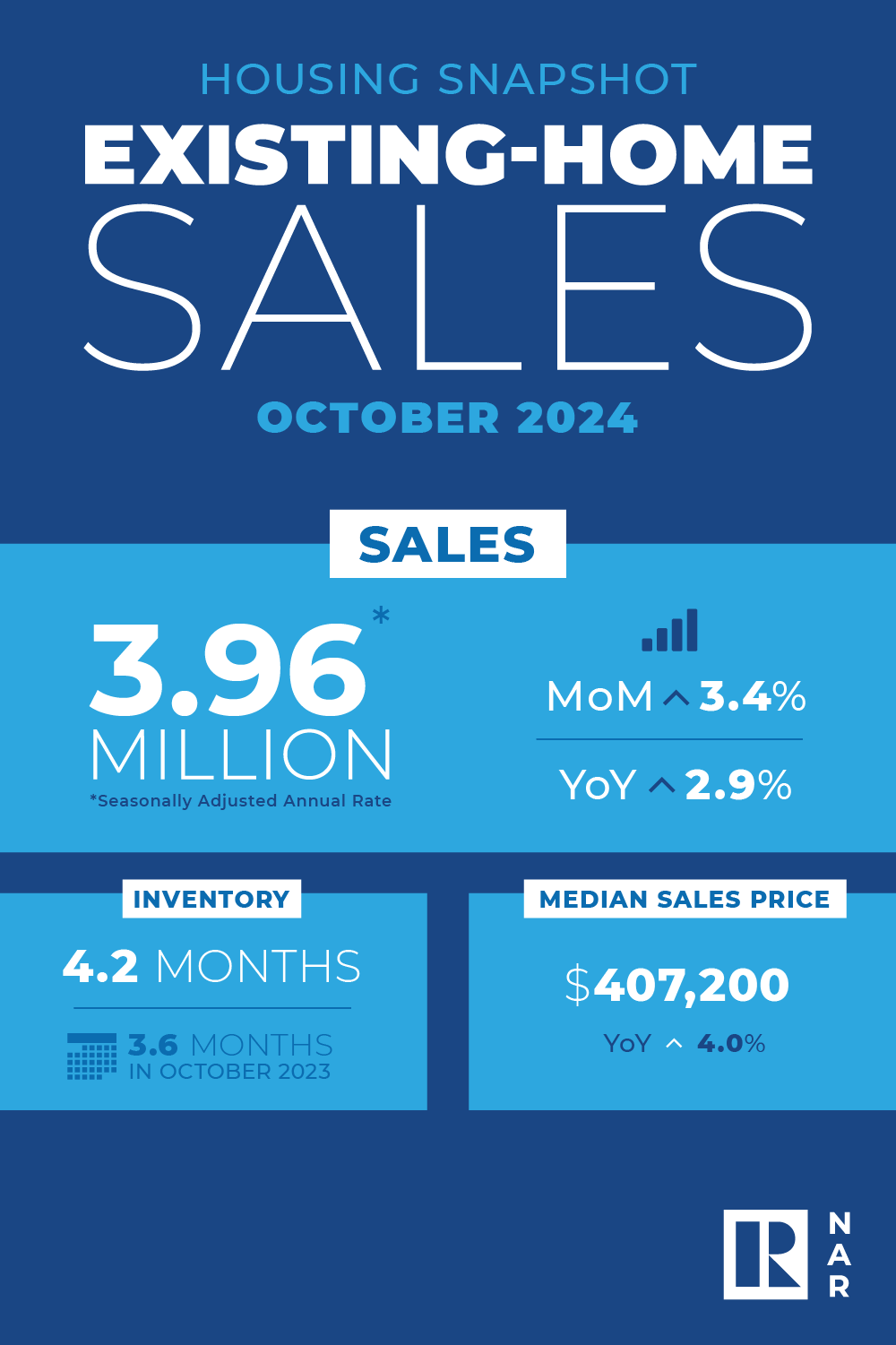
December 2024 National Overview
U.S. Real Estate Overview
Note: October 2024 data below are the most recent released by the National Association of Realtors.
Warranties for older homes
New homes come with warranties to protect the buyer in case of the unexpected. But what about existing homes? Fortunately, there are a number of companies today who offer warranties for existing homes. Sellers can now offer their buyers a level of assurance that was previously reserved for new construction, and buyers can buy with confidence! If you are in the market to buy or sell, ask us about the advantages of a home warranty. You might be surprised at how much protection is offered at a very reasonable price.
Seller strategy

Selling your home in today's market requires strategy and execution. Here are some tips to help sellers reduce their time on market while getting excellent value:
These simple tips can help you sell your home and take advantage of our today's market. Please contact us if you have any questions about selling your home. We are here to help!
Displaying blog entries 1-10 of 362